Translanguaging: Boost multilingual learning
Translanguaging is more than translating: the 'I say, I say, Compare' routine.
Translanguaging is so often misunderstood. The most common refrain I hear from teachers is, ‘isn’t it just translating’?
No. Emphatically. No!
Translation is a part of translanguaging, sure. But it’s only one part, and the wider strategy of translanguaging is highly powerful. Even better, once your learners have been trained to translanguage, it’s practically zero prep!
A zero-prep, highly effective strategy that boosts my learners’ ability to use high quality English? SIGN ME UP!
I’ve experimented with several strategies for translanguaging provided by Jacob Huckle. Jake proposes several translanguaging routines, and I’ve implemented several of these in my classroom. I’ll describe my favourite one here, but please go and look at his website and experiment yourself with his ideas.
The translanguaging routine I like the most is one Jake calls ‘I say, I say, Compare’. The process is simple, and for me, it looks something like this:
- First, give your students a task to complete. For example, ‘Describe how you make your favourite dish’.
- After a moment of thinking time, have your students work in pairs with a language partner to speak and complete the task, using their home language.
- Then, give students a piece of paper. Have them divide it into two columns. In one column, have them fully complete the task in their home language. At this stage, if they don’t know a word in their home language, they can ask their friends.
- Next, on the opposite side of the paper, students complete the task again, only this time in English. And this is where the magic happens. Challenge students to use as much English as possible, but allow them to ask their friends for words from their home language that they don’t know. They can also use a translator at this stage to translate words or short phrases, but don’t let them translate whole sentences! The key is to use as much English as possible.
- After that, students can colour code their work, linking ideas in their home language with ideas in English.
- Finally, students read their English work out to the class, complete with all of the new language they have gathered.
The final product should look something like this:
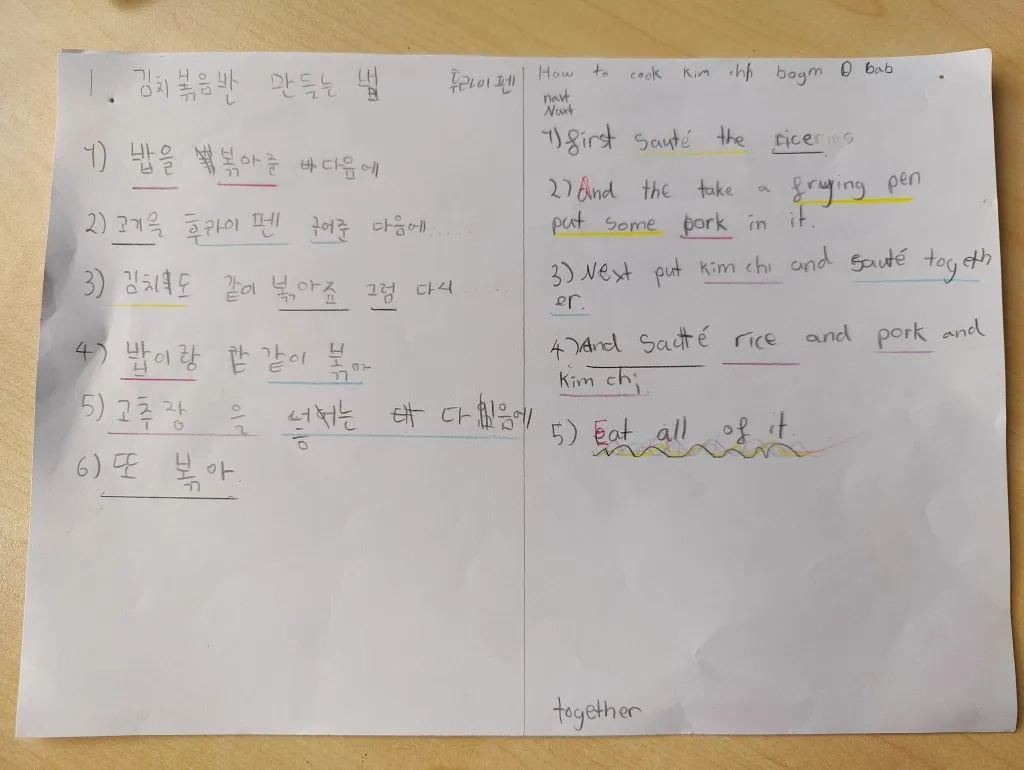
Translanguaging in action!
Think about what this strategy actually did. It did a lot of things! But in my view, it:
- Removed the language barrier, enabling students to use their full knowledge to complete a task.
- Supported language development in English as students built new vocabulary in context.
- Also possibly built new vocabulary in the student’s home language.
- Ensured that every student was able to complete the task to the maximum of their ability with the minumum of scaffold required.
And best of all, once learners have been trained into this process, it becomes an instinct. You can build it into your teaching with no extra prep work needed, and stretch students to go beyond what they might otherwise be able to do. Try it in your practice today!
Thanks again to Jake Huckle for all of his inspiring work on translanguaging. Please do go and see his website. It’s excellent!