Effective Questioning: The CCQ Framework
A three-level framework for concept checking questions that puts students at the centre of the lesson.
The teacher reads from the book: “the boys marched into the night, wearing the blackest clothes they could find to disguise themselves in the dark”. He stops and looks up from the book: “If you are in disguise you are wearing something so people can’t see you. You might wear something green if the things around you are green. If you are in the army you might wear a disguise.” The children stare at the teacher. They say nothing. The teacher looks back down at the book and continues reading: “As they walked down the street, one boy turned to the other and said…”
This vignette is based on what I saw when observing a colleague, during an EAL pull out session aimed at building oracy with two EAL learners. My colleague was a very experienced primary teacher, but had no formal training in TESOL or EAL. His approach to clarifying the word ‘disguise’ caught my attention.
Seasoned English language teachers will already be able to see a range of problems with the approach taken. The approach was very top-down, teacher-led, suggesting a transmissional approach to learning. There was no attempt to check understanding or explore the concept more deeply. The students were silent throughout the exchange.
Moreover, I didn’t just see some potentially problematic teaching practice. Rather, I saw a whole world of missed opportunity. If only my colleague had been trained to use CCQs, I thought to myself, which led me to reflect on the value of CCQs as a strategy. Whatsmore, it led me to see just how much we take the skillset of deploying effective questioning for granted.
Beginner TESOL teachers are inducted early on into the world of the concept checking question, better known as the CCQ. During my time as a teacher, I have come to understand CCQs as one of the critical cornerstones of effective language teaching. A good CCQ, or rather, a good series of CCQs, can perform a very wide range of functions. If delivered with skill and care, a series of CCQs about a new language item can, in an instant, perform a range of functions. They give teachers instant formative feedback on whether the students have understood the concept of the language they are studying; they can link new language concepts to students’ real life experiences, thus further securing meaning and language together; and, they can open up opportunities for students to talk at length, using the new language they have just been taught and further enhancing their oracy. All this through a simple questioning framework.
If we unpack the concept of a CCQ, we discover that not all CCQs were created equal. They take different forms and functions. My argument here is that these forms and functions can be combined into a series of CCQs which follow a simple pattern, exploiting the full power of the CCQ as a questioning strategy that maximises student involvement in their learning.
I therefore wish to propose a framework for delivering effective concept checking questions. Because, in my view, concept checking questions exist at three different levels. And these levels can be sequentially combined to put students at the centre of lessons.
We can start by dividing concept checking questions into three groups. In their most basic form, concept checking questions can take the form of simple closed questions, with ‘yes’ or ‘no’ answers, or simple single word answers. These questions are the simplest and most basic form of CCQ, designed to give the teacher some initial AfL, and an indication of whether the students have grasped the concept correctly.
For example, let’s imagine you are teaching the word ‘aeroplane’. Any of the following closed concept checking questions might serve the initial purpose of telling the teacher if the students have understood the concept of an aeroplane or not. They are closed questions, requiring ‘yes’ or ‘no’ or else single word answers:
- Is an aeroplane big or small?
- Can an aeroplane go underwater?
- Is an aeroplane noisy or quiet?
Good start! But, in fact, we can now proceed to do so much more with further CCQs to enrich the learning experience for our students beyond these simple closed questions. Taken on their own, these questions wouldn’t be satisfactory as a questioning strategy, representing IRF loops that centre on the teacher and not the students. So what’s next?
Well, a teacher might now choose to ask further concept checking questions which aim to guide students to link the new words to their own life experiences, or to their prior learning. These might take the form of more open questions than those asked previously, that open up more space for students to speak. Here are some examples of these mid-stage CCQs that build on the closed questions above:
- Where did you go the last time you went on an aeroplane?
- What do we call a person who flies an aeroplane?
- What different parts of an aeroplane do you know?
Notice that these questions perform two functions. Some link the concept of an aeroplane to the students’ own life experiences. Others link the concept to wider vocabulary, giving a student the chance to show what they know.
So far, so good! But now, the teacher might choose to deploy their CCQ ninja skills to maximum effect by deepening the concept even further, and by asking fully open questions. A simple way to formulate an open question is to begin it with the phrase ‘tell us about’. So, for example, we might ask the following fully open concept checking questions:
- Tell us about the last time you went on an aeroplane.
- Tell us why you like or don’t like flying on aeroplanes.
- Tell us about a movie you have seen that features aeroplanes.
Asking this kind of very open concept checking question gives students the opportunity to use their full range of language resources, developing their oracy whilst also securing new vocabulary concepts in their minds. They might talk in pairs before sharing with the class (also known as think, pair, share), or else simply be invited to respond fully.
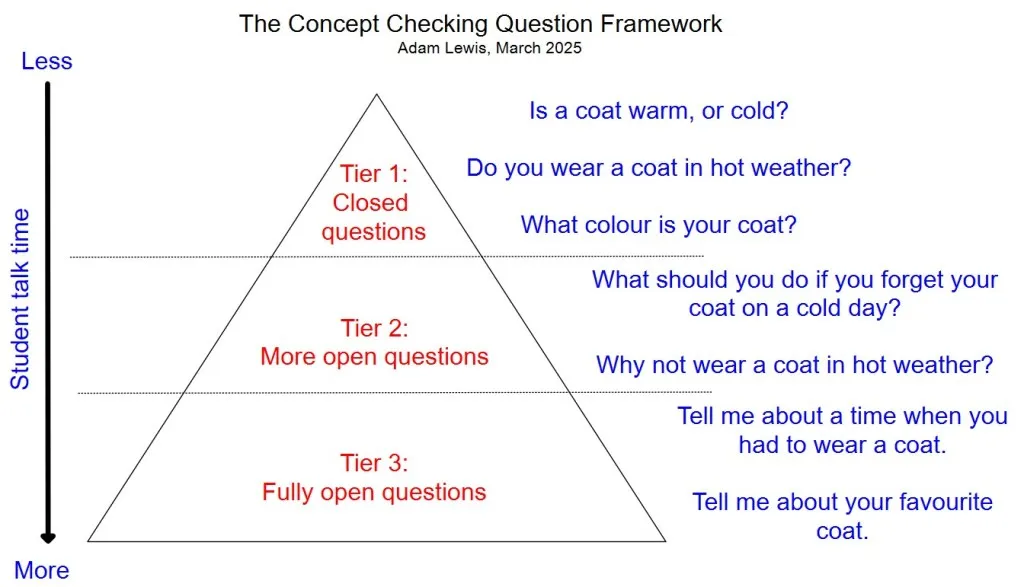
My proposal is that CCQs don’t exist in isolation. Rather, they can and should be combined together. A good series of concept checking questions moves through each of these three stages, from fully closed to fully open. In doing so, a teacher gets feedback on whether the students have understood the concept, anchors the concept to a student’s previous experiences and prior learning, and offers the students a chance to showcase their oracy skills whilst also practising the new vocabulary.
To help visualise this process, I have devised a concept checking question framework, as follows:
Task: Try it yourself. Think of a vocabulary word you’re going to encounter in your teaching this week. Could you build a series of three CCQs that follows this framework? With practice it becomes easier!
And, as a final example, let’s return to our teacher who helped us illuminate the problem at the beginning of this article. When teaching the word ‘disguise’, can we think of a series of three CCQs that follow this pattern? There are, of course, multiple possible answers, but allow me to propose the following as one possible solution:
- If you are in disguise, can somebody see you or not?
- Who might wear a disguise and why?
- Tell us about an animal that you know that can disguise itself.
In the space of three very brief questions, we have achieved a great deal. After time and practise following this framework, it will become a cornerstone of any language teacher’s pedagogical toolbox. Questioning is a skill we take for granted as language teachers, but I hope that the conceptualisation offered in this framework at least gives food for thought if not a practical approach that teachers will apply in their classrooms henceforth.